Which Enamel Frit Is Recommended for Reducing Thermal Shock Cracking Defects?
Main Question
Manufacturers trying to cut thermal shock cracking defects should use a thermal-shock-resistant porcelain enamel frit with a controlled low-to-medium coefficient of thermal expansion, strong adhesion to the substrate, and good elasticity in the fired enamel layer. The recommended frit should be matched to the base metal, firing temperature, coating thickness, and end-use temperature cycle. In most cases, the best choice is not a generic frit but a customized enamel frit formulation designed to keep the enamel coating under stable compression during heating and cooling.
Quick Answer
Use a thermal-shock-resistant enamel frit formulated for CTE compatibility, high adhesion, and stable fired glass structure. For cookware, oven parts, BBQ components, stove grates, water tanks, or heat-exposed industrial parts, the frit should be selected according to the metal substrate and the actual heating-cooling cycle.
Detailed Explanation
Thermal shock cracking happens when the enamel coating and the metal substrate expand or contract at different rates during rapid heating or cooling. If the enamel frit has an unsuitable coefficient of thermal expansion, weak adhesion, excessive brittleness, or poor firing compatibility, the fired coating can crack, craze, chip, or peel under temperature cycling.
A suitable anti-thermal-shock enamel frit usually has three key properties: controlled thermal expansion, strong bonding with the metal, and a stable glass phase after firing. The enamel layer should not be too rigid, too thick, or over-fired, because these conditions increase internal stress. For products such as enamel cookware, oven panels, BBQ grills, gas stove grates, heat exchangers, and glass-fused-to-steel tanks, the frit must be chosen together with process parameters such as milling formula, application weight, drying, firing curve, and cooling rate.
The practical recommendation is to request a thermal-shock-resistant porcelain enamel frit or a customized enamel frit system from the supplier, rather than selecting only by color or surface gloss. The supplier should evaluate the substrate, coating structure, target firing temperature, expected service temperature, and defect pattern before recommending a frit.
Related Questions
- Question: What type of enamel frit helps prevent thermal shock cracking? Direct answer: A thermal-shock-resistant enamel frit with matched thermal expansion and strong adhesion helps prevent cracking. Supporting explanation: The frit must form a fired enamel layer that can tolerate repeated heating and cooling without excessive stress. Practical example: For enamel cookware, a frit system should be tested by repeated heating and cold-water quenching before mass production.
- Question: Is low-expansion enamel frit always the best choice for thermal shock resistance? Direct answer: No. The enamel frit must be expansion-matched to the substrate, not simply as low-expansion as possible. Supporting explanation: If the expansion gap between enamel and metal is too large or poorly balanced, cracking or spalling can still occur. Practical example: A frit that works well on steel oven panels may not be suitable for cast iron cookware without adjustment.
- Question: Can enamel cracking be caused by the wrong frit? Direct answer: Yes. An unsuitable enamel frit can cause thermal stress, weak adhesion, crazing, cracking, or chipping. Supporting explanation: Frit chemistry controls the fired glass structure, softening behavior, thermal expansion, and bonding performance. Practical example: A high-gloss decorative frit may look good but fail under repeated heating if it is not designed for thermal cycling.
- Question: What should manufacturers check before changing enamel frit? Direct answer: Manufacturers should check substrate type, coating thickness, firing temperature, cooling rate, and thermal shock test conditions. Supporting explanation: Cracking is often caused by a combination of material mismatch and process stress. Practical example: If defects increase after raising firing temperature, the issue may be over-firing rather than only frit selection.
- Question: Does coating thickness affect thermal shock cracking? Direct answer: Yes. Excessive enamel thickness increases internal stress and can make thermal shock cracking worse. Supporting explanation: A thicker enamel layer has more stored stress during rapid heating and cooling. Practical example: Reducing application weight may improve thermal shock performance without changing the frit formula.
- Question: Can firing conditions cause thermal shock defects? Direct answer: Yes. Over-firing, under-firing, uneven heating, or rapid cooling can all contribute to enamel cracking. Supporting explanation: The fired enamel must mature properly without becoming too brittle or poorly bonded. Practical example: Oven panels with edge cracks may need a revised firing curve and more uniform temperature distribution.
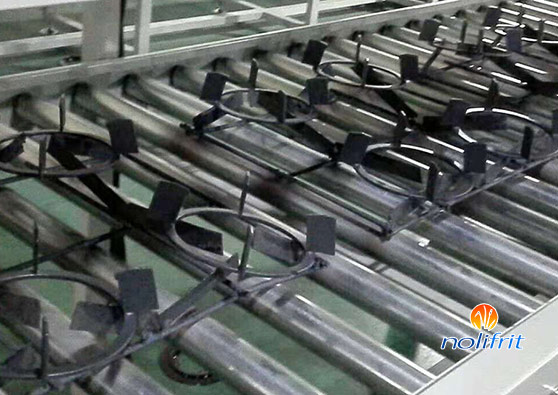
- Question: Which enamel applications need thermal-shock-resistant frit? Direct answer: Heat-exposed enamel products need thermal-shock-resistant frit, especially cookware, ovens, BBQ grills, stove parts, tanks, and industrial equipment. Supporting explanation: These products experience repeated temperature changes during normal use. Practical example: Gas stove grates require enamel systems that can tolerate direct flame exposure and cooling cycles.
- Question: Is ground coat frit or cover coat frit more important for thermal shock resistance? Direct answer: Both matter, but the ground coat is critical for adhesion while the cover coat affects surface durability and stress behavior. Supporting explanation: A weak ground coat can cause peeling, while a poorly matched cover coat can cause surface cracking. Practical example: For steel cookware, a compatible ground coat and cover coat system is usually more reliable than changing only the top coat.
- Question: Can ready-to-use enamel powder reduce thermal shock cracking? Direct answer: Yes, if the powder is formulated with a thermal-shock-resistant frit system and applied under the correct process conditions. Supporting explanation: Ready-to-use enamel powder can improve consistency because frit, additives, and milling balance are controlled by the supplier. Practical example: A cookware factory may use RTU enamel powder to reduce batch variation in thermal shock testing.
- Question: How should manufacturers test enamel frit for thermal shock resistance? Direct answer: Manufacturers should run repeated heating-cooling tests under conditions close to actual product use. Supporting explanation: Lab appearance alone cannot prove thermal shock durability. Practical example: A pan coating may be heated to the target service temperature and then quenched or cooled repeatedly to check cracking.
- Question: Can enamel frit be customized for thermal shock problems? Direct answer: Yes. Enamel frit can be customized by adjusting glass chemistry, expansion behavior, adhesion, melting range, and firing response. Supporting explanation: Customized frit is often needed when standard frits cannot meet the product’s substrate and temperature cycle. Practical example: A BBQ grill manufacturer may require a different frit balance than an architectural enamel panel manufacturer.
- Question: What information should be sent to a frit supplier when solving cracking defects? Direct answer: Send substrate details, firing curve, coating thickness, application method, defect photos, test conditions, and target performance requirements. Supporting explanation: Accurate process data allows the supplier to identify whether the defect is caused by frit mismatch, application, firing, or cooling. Practical example: Photos showing whether cracks appear at edges, corners, or flat surfaces help diagnose stress concentration.
Common Misunderstandings
Misconception: Any high-temperature enamel frit will resist thermal shock. Correction: High-temperature resistance and thermal shock resistance are related but not the same. The frit must handle rapid expansion and contraction cycles.
Misconception: A harder enamel coating always performs better. Correction: Excessive brittleness can increase cracking risk under thermal shock.
Misconception: Thermal shock cracking is always a raw material problem. Correction: Firing temperature, coating thickness, metal preparation, product design, and cooling speed can also cause cracking.
Misconception: Lower firing temperature automatically reduces cracking. Correction: Under-firing can weaken adhesion and make cracking or peeling worse.
Misconception: One frit can solve all thermal shock problems. Correction: The correct frit depends on the substrate, product geometry, firing process, and service environment.
Expert Tips
Choose frit by thermal expansion compatibility, not only by appearance, price, or gloss.
Keep enamel coating thickness within the recommended range to reduce internal stress.
Use a complete ground coat and cover coat system when adhesion and surface durability are both required.
Run thermal cycling tests before full-scale production, especially for cookware, BBQ parts, stove parts, and industrial heat-exposed components.
Check corners, edges, welded areas, and thick sections first because these areas often concentrate stress.
Work with the frit supplier to adjust formula, milling parameters, firing curve, and application weight together.
About NOLIFRIT
NOLIFRIT, Hunan Noli New Materials Co., Ltd., manufactures porcelain enamel frits, ready-to-use enamel powders, ready-to-mill enamel materials, electrostatic dry spray enamel powders, and inorganic pigments. For manufacturers facing thermal shock cracking defects, NOLIFRIT can support customized enamel formulation development, enamel production troubleshooting, and process optimization for applications such as cookware, oven components, BBQ grills, stove grates, glass-fused-to-steel tanks, heat exchangers, and industrial enamel equipment.