How Should Enamel Manufacturers Properly Degrease to Avoid Burn Marks?
In the enamel production process, manufacturers often encounter various enamel defect issues—one recent example is irregular burn marks appearing on the surface of an enamel hot pot. These burn marks have compromised the product's appearance and quality. In response, Nolifrit quickly formed a special team of technical engineers who, after 48 hours of continuous efforts, successfully identified the root cause and developed a solution, preventing economic losses for the client.
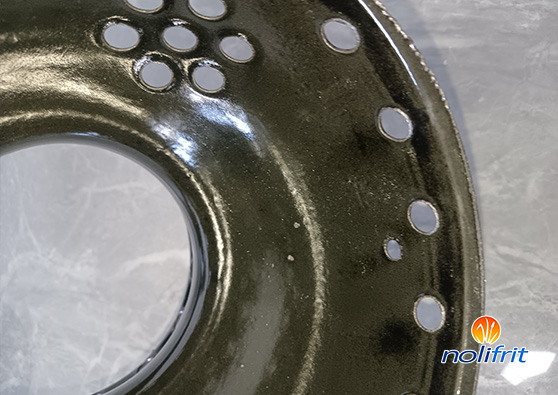
During the stamping process, iron blanks can retain stamping oil, rust-proof oil, and other greases on their surfaces. If these oils are not completely removed during the degreasing stage, they will quickly decompose into small gas molecules when entering the high-temperature firing stage of around 800°C. If these gases become trapped between the glaze layer and the iron blank and cannot be expelled in time, they can create depressions or dark burn marks on the glaze surface. In severe cases, this can lead to bubbling or peeling of the glaze layer. More critically, defects caused by improper degreasing often go undetected during the glazing and drying stages, only manifesting after high-temperature firing. This invisibly increases production costs and rework rates.
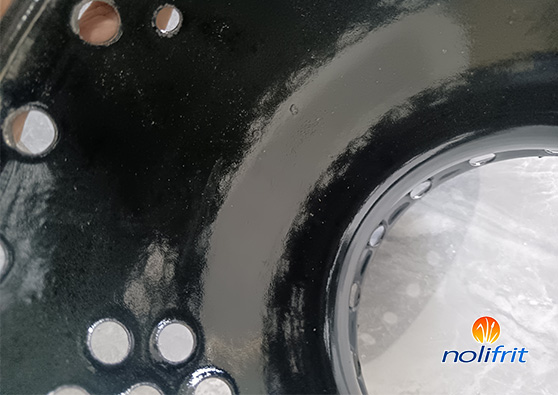
After identifying the root cause, the team at Nolifrit integrated the production process of enamel products and proposed three specific and actionable optimization suggestions:
1.Strict Control of Degreasing Solution ConcentrationIf the concentration is too low, the oils cannot be sufficiently emulsified and broken down; if too high, excessive foam may form, resulting in new residues on the surface of the iron blank. If the concentration falls below standard, the original solution should be promptly replenished to prevent the degreasing effect from being compromised.
2.Stabilize the Storage Temperature of the Degreasing Solution
Alkaline degreasing solutions are sensitive to temperature. If the storage environment is too cold, the activity of the degreasing solution will decrease; if too hot, it will accelerate the evaporation of its components. Maintaining the degreasing solution at a constant temperature of around 60°C ensures both its activity and prevents fluctuations in temperature from reducing degreasing efficiency.
3.Establish a Regular Replacement Mechanism for the Degreasing Solution
Over repeated use, degreasing solutions accumulate a significant amount of grease, metal shavings, and other impurities. Even with replenishment of the original solution, the overall degreasing capability will be greatly affected. Therefore, enamel manufacturers should set replacement cycles based on daily production volumes: for producing fewer than 500 pieces daily, change the degreasing solution every three days; for production exceeding 500 pieces, completely replace the solution before the end of each day and clean the storage tank to prevent impurities from affecting degreasing quality from the source.