Can cast iron enamel glaze and steel plate enamel glaze be used interchangeably?
In enamel production and enamel coating process, many people confuse the application scenarios of cast iron enamel glaze and steel plate enamel glaze. In fact, the two are completely incompatible. The core formula parameters, firing process characteristics, and substrate adhesion mechanisms of the two enamels are fundamentally different. Randomly mixing these two types of enamel material can lead to a series of quality defects such as enamel peeling, cracking, pinholes, and enamel bursting, seriously affecting the stability and service life of the finished enamel products.
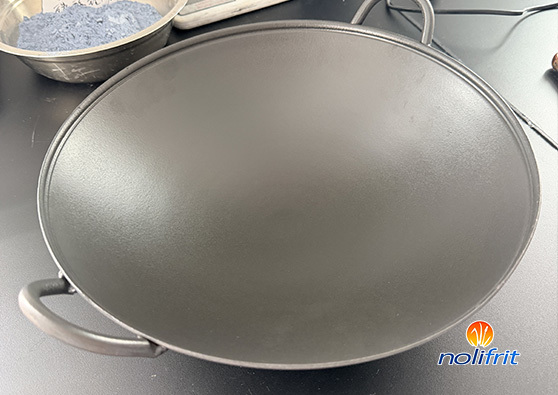
The difference in their coefficients of thermal expansion is the core factor preventing their interchangeability. Cast iron substrates have a loose microstructure, high carbon content, low coefficient of thermal expansion, and poor thermal stability; while steel substrates have a uniform texture, extremely low carbon content, higher coefficient of thermal expansion, and stable deformation patterns. Special cast iron enamel glazes have expansion parameters precisely matched to the characteristics of cast iron substrates, buffering stress differences during firing and cooling; steel enamel glazes, on the other hand, are adapted to the expansion characteristics of steel plates. Interchanging them will lead to a stress mismatch between the enamel layer and the substrate, ultimately resulting in enamel cracking and peeling.
There are significant differences in the firing temperature systems. Cast iron enamel glaze is suitable for low-temperature, slow-firing processes, which are well-suited to the heat absorption and dissipation characteristics of thick-walled cast iron parts, thus preventing casting deformation and excessive carbon precipitation. Steel plate enamel glaze, on the other hand, has a higher firing temperature and a faster firing pace. If used on cast iron substrates, it can cause overheating and oxidation of the cast iron, deformation of the substrate, and the glaze layer is also prone to bubbles and pinhole defects.
The adhesion mechanisms are also fundamentally different. Cast iron enamel relies on specially engineered enamel frit compositions to seal the porous cast iron structure, suppress carbon precipitation, and achieve strong bonding through a combination of mechanical interlocking and chemical adhesion. Steel plate enamel, by contrast, primarily develops adhesion through chemical reactions with the oxide layer formed on the steel surface. Since it lacks the ability to seal pores and control carbon migration, it cannot adapt to the porous, high-carbon characteristics of cast iron substrates. As a result, using steel enamel on cast iron leads to poor adhesion and significantly increases the risk of large-area enamel peeling.
In summary, cast iron enamel glaze and steel plate enamel glaze are specifically engineered for different substrate materials. To ensure product quality, durability, and long-term performance, they should always be selected according to the substrate and should never be interchanged or substituted.